
When Keya Baker started working as a housing manager at Trenton Housing Authority three years ago, she noticed something. The communication between management and residents wasn’t working. “I was able to see some of the things that are missing in regards to effective communication between management and our residents and community,” Baker said. “And so I wanted to create something that created an open dialogue of us explaining things. But in a friendlier atmosphere. In a more supportive atmosphere.”
That gap led to a partnership with Isles that may be breaking new ground in public housing.
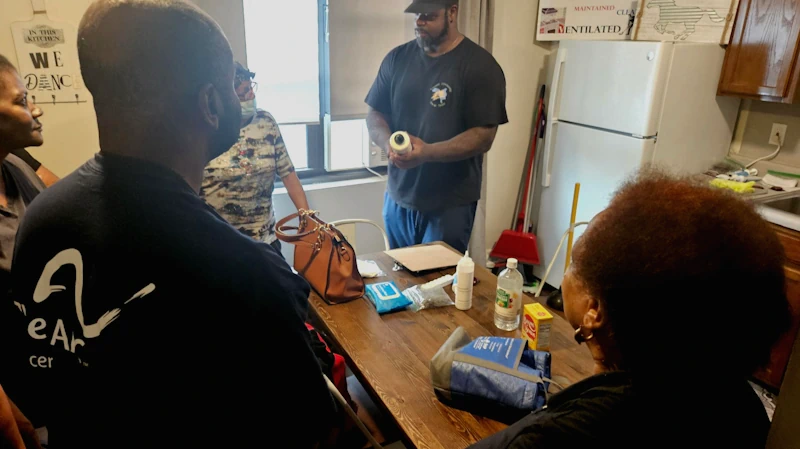
Since late 2024, Isles’ Center for Energy and Environmental Training has been delivering “8 Keys to Healthy Home” workshops to Trenton Housing Authority tenants. The training is now a required part of THA’s onboarding process for new tenants and transfers. So far, 160 people have completed the program. The collaboration came together when Baker, now THA’s Family Self-Sufficiency Coordinator, was developing an onboarding process with other staff. Andre Thomas Sr., director of training and support at Isles CEET, happened to be in the meeting. “Andre was there in that meeting,” Baker said. “And he mentioned we can go off the eight key principles of healthy living. And it just connected.”
For Thomas, who has been teaching Healthy Homes classes since 2011, this partnership represents something unusual. “We’ve never done it in a position where the landlord is initiating this education,” Thomas said. “It was always tenants who were vulnerable to the landlord, educating them because of their vulnerability to landlords, or because landlords were just absent and not involved.” The program flips that dynamic. THA is proactively teaching its 1,700 families how to maintain healthy homes. Thomas sees it as a win for both sides. “This education not only helps the tenant maintain a better, healthier unit, but it’s also a win because they’re taking care of the units that belong to the Housing Authority,” he said.
The training covers the eight keys: keeping homes clean, safe, dry, ventilated, pest-free, contaminant-free, well-maintained, and addressing combustion concerns. For THA, which manages older buildings, the lessons are practical. Thomas discusses identifying water leaks, using proper cleaning products, and understanding no-smoking policies. “Things that, if unaddressed, would become very expensive,” Thomas said. THA has a unit on site for the training, which allows residents to see the principles in action. “What we like about it is it’s in real time,” Baker said. “They’re able to see and have a vision of what their expectations are, full circle.”
The onboarding process now includes four stops. New tenants meet with a manager who explains expectations. They meet with an accountant. They meet with Baker to learn about resident services. Then they head to the Healthy Homes unit for the Isles training. Class sizes range from five to 30 people. Because the training is mandatory for everyone, residents seem more receptive to it, Thomas said. “When you do it in that way, they’re more receptive to it,” he said. “It’s like, oh, this is what every tenant has to go through, as opposed to singling them out and saying, you have to take this training.”
The partnership is already expanding. THA conducts annual home inspections, and some families fail them. Baker sees those failures as teaching opportunities rather than disciplinary moments. “A lot of it isn’t about someone just not wanting to take care of their home,” she said. “Some people just don’t know how. And they don’t understand the importance of it being healthy and their responsibility.” Starting in 2026, THA plans to require residents who fail inspections to take the Healthy Homes training. “It’s a softer opportunity for them to learn how to keep it up,” Baker said.