
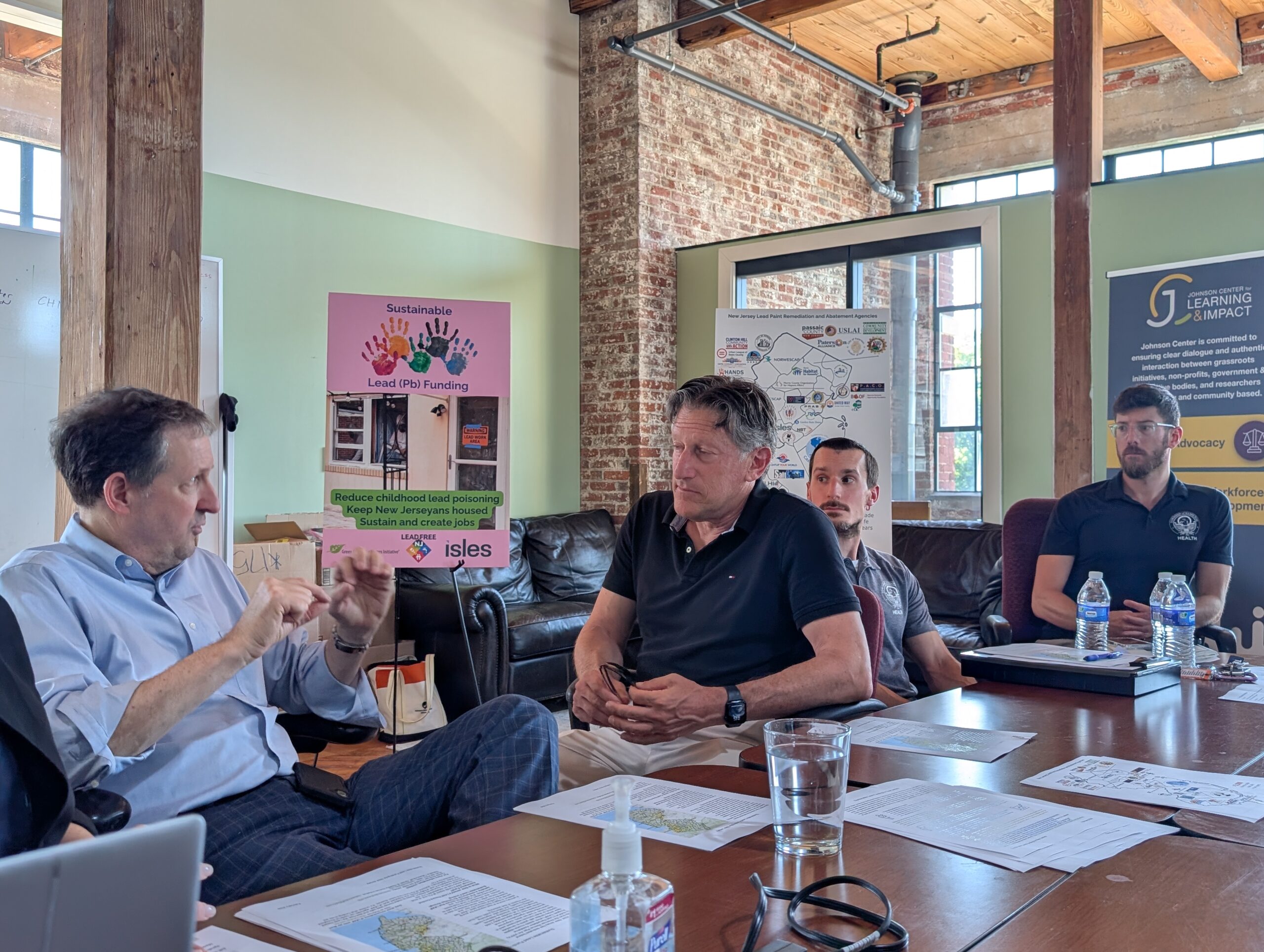
Last week, the Isles Johnson Center for Learning and Policy welcomed Senator Andrew Zwicker (LD-16) for a site visit centered on one of the most urgent health issues facing New Jersey families: lead exposure in the home. The visit brought together public health leaders, township officials, and advocates to see Isles’ lead and healthy homes work up close to discuss Budget Resolution 276. BR 276 calls to fully fund the Lead Hazard Control Assistance Fund, in which Senator Andrew Zwicker from LD 16 is a Prime Sponsor on.
The stakes are high. Lead dust from deteriorating paint accounts for up to 90% of elevated blood lead levels in children, and it does the most harm to kids under 6, with lasting effects on learning, behavior, and earning potential. In New Jersey, an estimated dozen children are lead-poisoned every single day.
The encouraging news is that New Jersey has built the most robust lead remediation network in the country, and it is fully operational today. More than 45 DCA Lead Safe Agencies work across every county, and in 2025 alone they made more than 1,400 units lead-safe. Income-qualified residents can receive up to $30,000 in free lead hazard control work on their homes. At Isles, this work has been part of our mission for 17 years, and our community health workers test more than 250 homes each year.
The threat isn’t a lack of capacity. It’s a funding cliff. With federal ARPA funding expiring at the end of 2026, the state’s annual investment in lead remediation is set to fall back to less than $10 million a year, a figure set when the program was far smaller. Without action, New Jersey stands to lose roughly 100 jobs and see 10 to 30 Lead Safe Agencies shut down or scale back, leaving the communities that need help most without accessible services.
This is a solvable problem, because the funding mechanism already exists. The Lead Hazard Control Assistance Fund, established in 2003, is tied to a dedicated revenue stream from paint sales tax and inspection fees that generates an estimated $19 million or more per year. The problem is that the money has routinely been diverted into General Revenue instead of being used for its intended purpose. Fully funding the LHCAF through BR 276 would let New Jersey make 1,400 to 1,600 additional homes lead-safe every year and chart a credible path to eliminating residential lead hazards statewide.
That was the case advocates made to Senator Zwicker. The pieces are all in place: certified contractors, trained community organizations, a dedicated revenue stream, and decades of proven results. What’s missing is a commitment from the Legislature to protect this infrastructure before the FY2027 budget is finalized. We’re grateful to Senator Zwicker for taking the time to see this work, and for standing with the families it serves.